
Household money
Building an emergency fund on a ₹30,000 salary: start with the monthly gap
A fictional ₹30,000 household budget shows how a ₹5,000 monthly saving can build a buffer in stages—and what changes when essential costs leave less room.
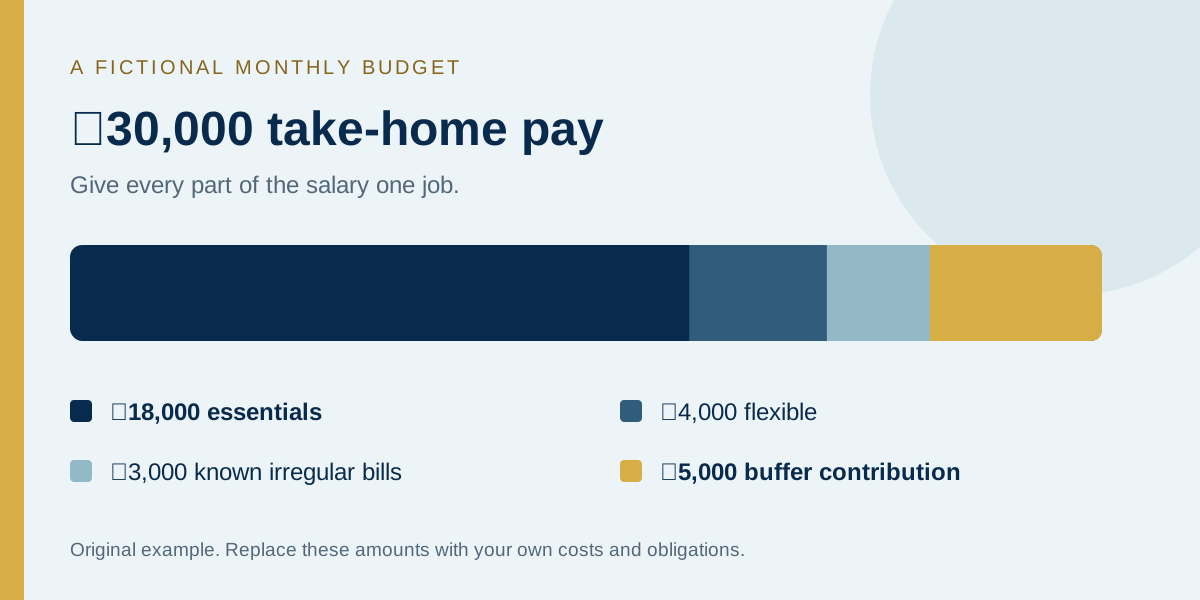
Begin with what remains after essential bills, minimum debt payments and foreseeable expenses. Build a small accessible buffer, then a target based on your own essential costs. A salary figure alone cannot determine the right target or monthly contribution.
Start with the gap you can sustain
Meet a fictional reader, Meera, whose monthly take-home pay is ₹30,000. Her first task is to list the spending she would still need to meet during an income interruption. She includes rent, basic food, transport, utilities and minimum debt payments. She also sets aside money for bills she already knows are coming. Those annual costs should not be disguised as emergencies simply because they do not arrive every month.
| Allocation | Amount |
|---|---|
| Essential bills and minimum debt payments | ₹18,000 |
| Flexible spending | ₹4,000 |
| Provision for known irregular bills | ₹3,000 |
| Emergency-fund contribution | ₹5,000 |
| Total take-home pay | ₹30,000 |
A useful first milestone is smaller than the final target
With ₹5,000 available each month and no starting balance, Meera reaches ₹10,000 after two contributions. This does not solve a long interruption, but it creates a first line of defence against a smaller unexpected cost. The first milestone makes progress visible without pretending that the final target can be reached immediately.
In this example, three months of the stated ₹18,000 essential costs is ₹54,000. Six months is ₹1,08,000. At an unchanged ₹5,000 contribution, the balance first exceeds those amounts after eleven and twenty-two months respectively. These are scenarios, not universal prescriptions. Income stability, dependants, health cover and other obligations can change both the target and the pace.
| Milestone | Contributions needed | Balance at that point |
|---|---|---|
| Starter buffer: ₹10,000 | 2 months | ₹10,000 |
| One month of stated essentials: ₹18,000 | 4 months | ₹20,000 |
| Three months of stated essentials: ₹54,000 | 11 months | ₹55,000 |
| Six months of stated essentials: ₹1,08,000 | 22 months | ₹1,10,000 |
A smaller surplus changes the timeline, not your worth
If rising rent reduces the monthly contribution to ₹2,000, reaching ₹54,000 takes twenty-seven contributions under the same simplified assumptions. A rule telling every ₹30,000 earner to save the same percentage ignores that difference. Recalculate after looking at real bills. Do not borrow at high cost merely to display a larger savings balance.
A salary increase or bonus can shorten the timeline, but only count money that actually arrives and remains after its other commitments. If the fund is used for an emergency, record the withdrawal and reset the next milestone. A plan that allows rebuilding is more useful than a target that assumes life never interrupts it.
The buffer’s job is access when income is disrupted
NISM’s emergency-fund material places safety and liquidity ahead of earning high returns. Apply that question to the actual account or product: how quickly can you withdraw, what restrictions apply, and what value uncertainty or penalties could arise? Do not assume that money required urgently will be available simply because a product can usually be sold.
Keep a clear record of where the buffer is held and how it can be accessed. Review the target when rent, family responsibilities or essential debt payments change. Long-term investing and known annual bills serve different jobs. Naming those jobs helps prevent the same ₹5,000 from being counted three times.